Disclaimer: The information in this article is for educational purposes only and does not constitute medical advice. Always consult a qualified healthcare professional before making changes to your health regimen.
Most hyperbaric oxygen clinics start with a catalog. They pick a chamber from a supplier, bolt it into a spare room, and call it a wellness offering. Age Back Clinic in central Stockholm started somewhere else entirely: with the observation that a therapy hospitals have trusted since the 1960s still makes most people feel like they are being sealed into a submarine porthole for an hour — and a refusal to accept that this is simply how hyperbaric oxygen therapy has to feel.
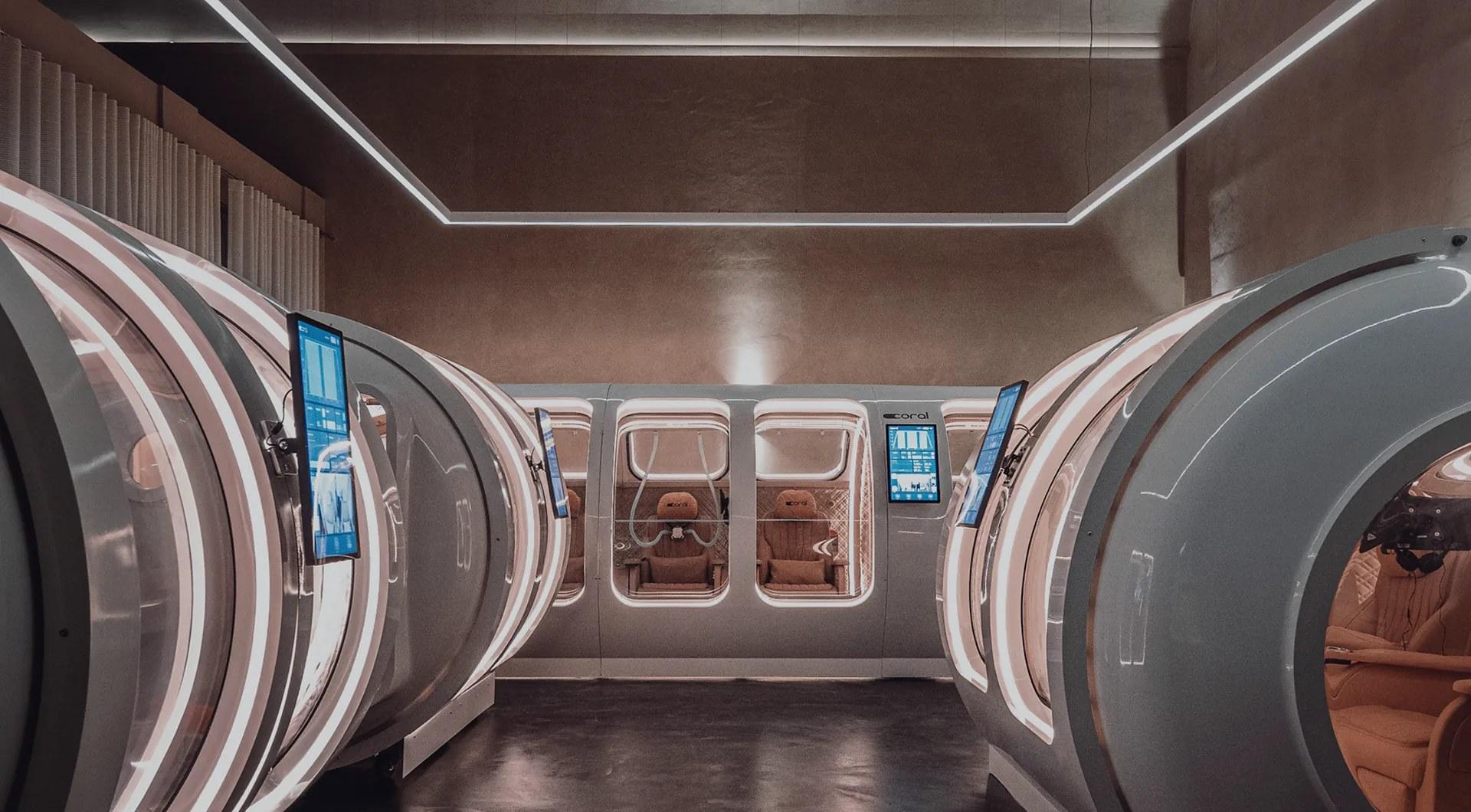
What they built instead is not a clinic with a hyperbaric chamber in it. It is what they call an oxygen park — a purpose-engineered pressure vessel co-developed from scratch, wrapped in a hospitality experience closer to a private members' lounge than a hospital corridor, and stacked with complementary technologies so a single visit can do considerably more than raise your blood oxygen for an hour.
This article profiles the innovation behind Age Back Clinic Stockholm: the engineering decisions behind its chamber, the safety systems built into every session, and why the "oxygen park" model may be a preview of where serious longevity clinics are headed.
A Different Kind of Innovation Story
Most profiles in this series introduce a single founder with a lab coat and a origin story. Age Back Clinic's innovation story is a little different — it is an engineering and hospitality achievement built by a team, centred on a single, uncompromising idea: hyperbaric oxygen therapy is clinically valuable enough that it deserves infrastructure built specifically for it, rather than infrastructure borrowed from elsewhere.
The result sits in central Stockholm: seven first-class seats spread across two chambers, treatment at a full 2.0 ATA — the pressure most published clinical HBOT protocols are actually built around — and 93% (±3%) oxygen delivered through an individual mask rather than mixed into shared chamber air. No membership. No physician referral required. Sessions run daily, and the clinic's stated ambition is blunt: to operate what it calls the most advanced hyperbaric oxygen park in Europe.
Age Back Clinic on Biohacker Alliance →
From a Tube to a Lounge: Rethinking What HBOT Should Feel Like
To understand what Age Back Clinic actually innovated, it helps to understand what a typical HBOT session looks like almost everywhere else. Most clinics, including many reputable ones, still rely on a narrow acrylic tube or a soft-shell inflatable bag that you lie flat inside for the full session. Pressure in these systems commonly tops out around 1.3 to 1.5 ATA — noticeably below the pressure that most of the clinical research on HBOT protocols is actually designed around. Oxygen is often mixed into the general chamber air rather than delivered through an individual mask, meaning purity and concentration can vary considerably between sessions and between providers. And because most clinics operate a single chamber, availability is often limited to whatever slot is left on a long waiting list.
HBOT elsewhere is a tube. Here, it is first class.
Age Back Clinic's session looks structurally different at every one of those points. Guests sit — not lie — in electronically adjustable leather recliners inside a seated cabin. The chamber reaches a full 2.0 ATA. Oxygen arrives at 93% (±3%) purity through a personal mask, not shared chamber air. And with seven seats split across two chambers, the clinic can run private two-person sessions, solo sessions, or group sessions for up to five people simultaneously — a capacity no single-tube clinic can realistically match, and one that translates directly into shorter waits and more flexible scheduling.
None of this is cosmetic. Sitting upright rather than lying flat, breathing through an individually fitted mask rather than shared air, and treating at a clinically standard pressure rather than a diluted one are all decisions that shape what the therapy can realistically deliver — and whether people actually complete a multi-session protocol instead of abandoning it after two uncomfortable visits.
Engineering an Omega-Shaped Pressure Vessel
The centrepiece of the innovation is the chamber itself, and it is worth being specific about what "co-developed from the ground up" actually means here: Age Back Clinic did not select a vessel from an equipment catalog. It worked directly with manufacturers to engineer a chamber shape that does not exist, in this form, anywhere else — an omega-shaped, medical-grade pressure vessel built in solid, certified hard-shell steel rather than the soft-shell or acrylic-tube designs common elsewhere in the industry.
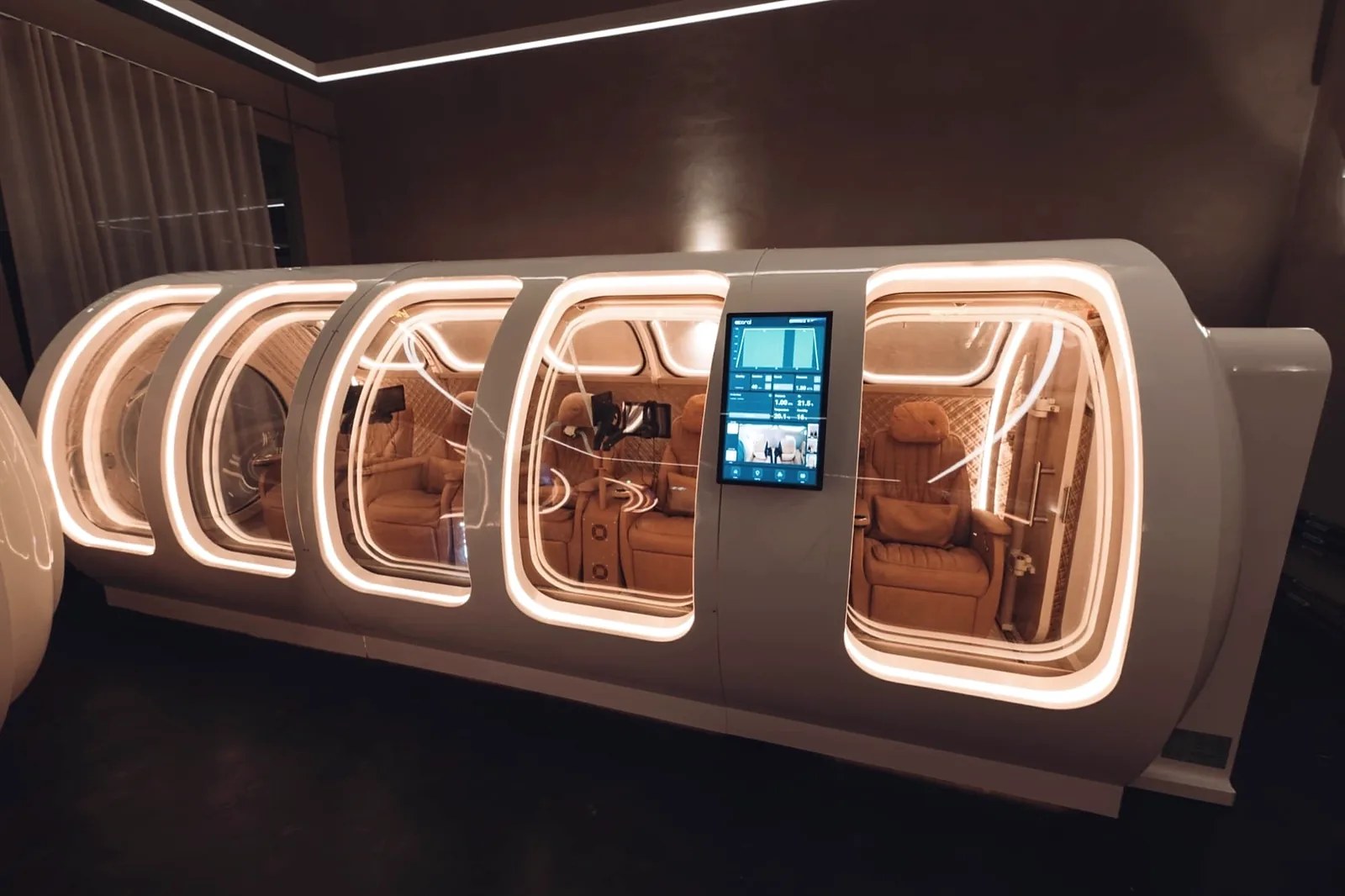
The omega shape is not a styling choice — it is a structural one. By distributing pressure evenly around the cabin, it opens up usable interior space that a straight cylindrical tube cannot offer at the same treatment pressure, making room for four people to sit comfortably side by side without the closed-in feeling that keeps many people out of hyperbaric chambers in the first place. Combined with a panoramic acrylic dome, ambient lighting and climate control, the cabin is designed to be occupied for 65 to 95 minutes at a stretch without triggering the mild claustrophobia that keeps a meaningful share of prospective patients from ever finishing a course of treatment.
Underneath the design work sits a serious certification stack: the pressure vessel is engineered and certified to the EU's 2014/68/EU Pressure Equipment Directive, with ASME and ISO compliance carried through the manufacturing chain. In an industry where "hyperbaric" is sometimes used loosely to describe consumer-grade inflatable bags, that distinction matters — it is the difference between a wellness gadget and a certified medical device.
Safety Engineered Like a Medical Device
Innovation in a pressurized medical environment is not just about comfort — it has to be about safety engineering, and this is where Age Back Clinic's build quality shows most clearly. Every session runs under continuous, logged monitoring: oxygen concentration, pressure, temperature and humidity are sampled in real time and recorded for every single session, not spot-checked periodically.
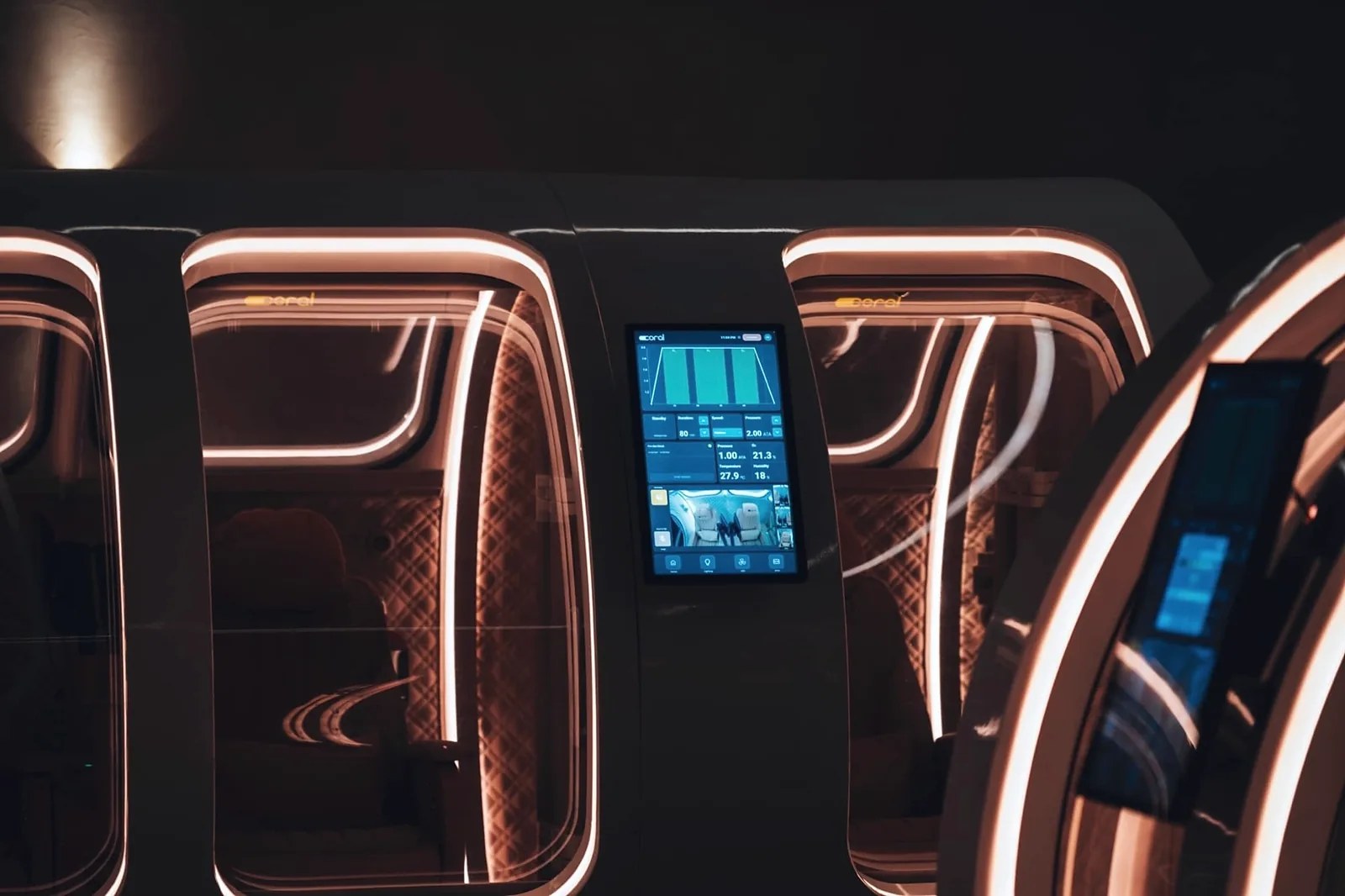
- Automatic O₂ switchover — onboard monitoring triggers an automatic switch between oxygen and ambient air the instant a reading falls outside the safe range, without waiting for a manual operator response.
- Dual exits — the chamber door can be released from inside the cabin as well as from outside, removing any single point of failure in an emergency.
- Continuous human monitoring — a two-way intercom and a continuous camera feed keep an operator in contact with guests throughout the entire session, from compression to decompression.
- Human oversight at every phase — an operator watches every reading live through the full session, rather than relying solely on automated alarms.
It is a system engineered, in the clinic's own words, "like a medical device, experienced like a lounge" — and that combination, rather than either half of it alone, is the actual innovation.
Recommended Products
Top-rated innovators supplements & tools on amazon.com
NMN Supplement
NAD+ precursor for cellular energy
View on amazon.com
Resveratrol
Sirtuin activator & antioxidant
View on amazon.com
Collagen Peptides
Skin, joint & tissue support
View on amazon.com
* Affiliate links — Biohacker Alliance earns a small commission at no extra cost to you. Products shown are selected for relevance to Innovators.
Building an Oxygen Park, Not Just a Chamber
Perhaps the most forward-looking part of Age Back Clinic's model is that hyperbaric oxygen is treated as the anchor of a broader protocol rather than the entire offering. NASA-grade near-infrared light therapy, HIFEM body and face treatments, PRP/PRF, and IV nutrient drips all run under the same roof, so a single visit can combine several modalities instead of sending patients to three different addresses across the city.
- NASA-grade infrared light — near-infrared therapy built on two specific wavelengths: 880 nm, originally researched by NASA for its effects on mitochondrial function, and 660 nm, more commonly associated with skin and hair. Paired with a hyperbaric session, guests combine elevated oxygen delivery with light-stimulated cellular energy production in a single visit — every new guest receives a complimentary 5-minute session with their first HBOT booking.
- HIFEM (Emsculpt Neo, Emsella, Emface) — high-intensity focused electromagnetic technology that triggers thousands of supramaximal muscle contractions, scheduled around chamber time so that the oxygen-rich blood from an HBOT session can support the recovery that intense stimulation demands.
- PRP/PRF and IV drips — regenerative and nutrient-based protocols layered on top of the core oxygen therapy for guests pursuing a more comprehensive longevity or recovery plan.
This "stack" approach mirrors a broader shift happening across serious longevity medicine: rather than treating each intervention as an isolated purchase, clinics are increasingly designed around combinable protocols that compound each other's effects — which is precisely the model Age Back Clinic has engineered its physical space and scheduling around.
A 65-Minute Session, Minute by Minute
Every session at Age Back Clinic follows a controlled, three-phase pressure profile, always under live operator supervision:
- Compression (~10 minutes) — the cabin pressurizes gently while guests settle in, equalizing their ears the same way they would on a flight, with an operator watching every reading live throughout.
- Treatment at depth (~45 minutes) — guests breathe 93% (±3%) oxygen through their own individual mask at a full 2.0 ATA. Because the environment is a seated lounge rather than a horizontal tube, this is where the design difference is most tangible: guests can read, rest, talk to a chamber companion, or simply close their eyes, with recline controls within reach the entire time.
- Decompression (~10 minutes) — pressure returns to sea level in controlled steps, and guests walk out and continue their day rather than needing recovery time.
A longer 95-minute option extends the time spent at full treatment depth for guests following more intensive protocols, without changing the structure of compression and decompression around it.
Structured Like Clinical Research, Not Single Visits
One detail distinguishes Age Back Clinic's business model from a typical wellness studio: it prices and structures hyperbaric therapy the way the clinical research behind HBOT is actually designed — as a series, not a one-off treat. Most published HBOT protocols run somewhere between 22 and 40 sessions across consecutive weeks, and single-session HBOT is rarely where the clinically meaningful effects show up.
Age Back Clinic mirrors that structure directly, offering fixed protocols of 10, 22 or 40 sessions at the standard per-session rate, rather than pushing guests toward large upfront prepayment packages with complicated redemption terms. Every protocol begins with an intake consultation, and scheduling is built around the guest's own week rather than a rigid template. It is a quietly significant innovation in its own right: treating hyperbaric oxygen with the seriousness of a structured clinical course rather than the marketing logic of a spa membership.
Why This Kind of Innovation Matters for the Future of Longevity Medicine
It is tempting to read a story about chamber shapes and control panels as a story about luxury. It is really a story about adherence. The single biggest obstacle to hyperbaric oxygen therapy delivering on its clinical potential has rarely been the physics of pressurized oxygen — it has been getting people to actually complete a 10-, 22- or 40-session protocol inside equipment that, for decades, has looked and felt more like an MRI machine than somewhere you would choose to spend an hour.
By re-engineering the chamber itself, building safety systems that would satisfy a hospital, and then wrapping the entire experience in the comfort of a members' lounge, Age Back Clinic has effectively removed the excuse. That is what separates genuine innovation from a marketing refresh: it does not just make hyperbaric oxygen therapy feel nicer — it makes it more likely that people actually finish the course of treatment the research says they need. For a modality this well-studied, that may be the single most consequential innovation of all.
See the full Age Back Clinic Stockholm profile on Biohacker Alliance →
→ More longevity experts and clinics in Stockholm
→ Explore the full Biohacker Alliance directory
Ready for Your Next Upgrade?
Discover verified biohacking experts, curated insights, and a community built around human optimization.
Frequently Asked Questions
What makes Age Back Clinic's hyperbaric chamber different from other HBOT clinics?+
How long is an HBOT session at Age Back Clinic and what happens during it?+
Do I need a membership or a doctor's referral to book HBOT at Age Back Clinic?+
Disclaimer: The information in this article is for educational purposes only and does not constitute medical advice. Always consult a qualified healthcare professional before making changes to your health regimen.