Disclaimer: The information in this article is for educational purposes only and does not constitute medical advice. Always consult a qualified healthcare professional before making changes to your health regimen.
Advertising disclosure: This article contains affiliate links. If you buy through them, Biohacker Alliance may earn a commission at no extra cost to you. Quicksilver Scientific is an official partner of Biohacker Alliance. Our editorial assessment is independent.
Quick answer: Binder supplements are made of materials such as activated charcoal, clay, zeolite or fiber that can attach to other substances in the gut. They are popular in functional medicine, often discussed under terms like "biotoxin binder". Laboratory data show that these materials bind many substances, but there is little research in healthy people showing a clear health benefit from taking them as supplements. If you consider them, use them for a defined purpose, ideally with a practitioner, and keep them well apart from food, supplements and medication.
What is a binder?
A binder is a substance that is not absorbed itself and passes through the digestive tract. On its way, it can hold on to other molecules through its surface (adsorption) or its electrical charge, and both leave the body together with the stool.
Some binders are established in medicine. Activated charcoal, for example, is used in hospitals in certain cases of poisoning, and cholestyramine is a prescription drug that binds bile acids. Supplement binders borrow this principle but are sold for general use.
Common binder ingredients
| Ingredient | What it is | What is known |
|---|---|---|
| Activated charcoal | Highly porous carbon | Binds a broad range of substances in the gut; also binds medications and nutrients. In the EU it carries an authorised claim: it contributes to reducing excessive flatulence after eating (1 g at least 30 minutes before and 1 g shortly after a meal). |
| Bentonite clay | Natural clay mineral | Binds substances through its layered, charged structure; human data for supplement use are limited. |
| Zeolite (clinoptilolite) | Volcanic mineral with a cage-like structure | Binds certain positively charged particles in lab studies; human evidence is limited. |
| Chitosan | Fiber from crustacean shells | Binds fats and bile acids; not suitable for people with shellfish allergy. |
| Gum arabic and other fibers | Soluble fiber | Gentle; supports bowel regularity and feeds gut bacteria. |
| Thiol-functionalized silica | Silica with sulfur groups | A newer ingredient designed to bind metals; very little independent human research. |
What does the evidence say?
- Lab and animal studies show that charcoal, clays and zeolites bind many compounds.
- Human studies on binder supplements in healthy people are few, small and often funded by manufacturers.
- No binder supplement is approved to treat mold illness, heavy metal exposure or any other condition. Suspected exposure to toxins belongs in medical hands, with testing and proper treatment.
In short: the mechanism is plausible, but the health benefit for everyday use is not proven.
Binders vs. dietary fiber
Many fibers also bind substances in the gut. Soluble fibers such as psyllium, oat beta-glucan and pectin bind bile acids, which is why oat beta-glucan carries an EU-authorised claim: it contributes to the maintenance of normal blood cholesterol levels (3 g per day). Fiber also supports regular bowel movements, which matters because a binder only helps if what it binds actually leaves the body.
For many people, eating 25–30 g of fiber per day from vegetables, legumes, whole grains and seeds is the first and gentlest step before thinking about a dedicated binder.
Who should not take binders without medical advice
- People who take prescription medication, especially thyroid hormones, blood thinners, anti-epileptics, antidepressants or the contraceptive pill.
- People with constipation, bowel obstruction or inflammatory bowel disease.
- Pregnant or breastfeeding women.
- Children.
- People with a shellfish allergy (products containing chitosan).
- People with kidney disease (some clays contain minerals such as aluminium or sodium).
How to take a binder safely
- Timing: take binders at least 2 hours apart from medication, supplements and nutrient-rich meals, because they can bind those too.
- Water: drink plenty, as binders can cause constipation.
- Start low: begin with a small amount and see how your digestion reacts.
- Limited periods: use binders for a defined time and purpose rather than indefinitely.
- Ask first if you take prescription drugs (including the contraceptive pill), are pregnant or breastfeeding, have a bowel condition, or have a shellfish allergy (chitosan).
How binders are discussed in functional medicine
In functional and integrative medicine, binders are often part of a wider plan that a practitioner tailors to the individual, typically together with diet changes, testing and support for regular digestion. Practitioners differ widely in how they use them, and these approaches are based mainly on clinical experience rather than controlled trials.
If a practitioner suggests a binder, these questions help you make an informed decision:
- What exactly is the goal, and how will we know whether it worked?
- Which test results support using a binder in my case?
- Which binder, which dose and for how long?
- How should I time it around my medication and other supplements?
- What side effects should make me stop or check in?
A good practitioner will answer these clearly and will not promise a cure.
Recommended Products
Top-rated nutrition & supplements supplements & tools on amazon.de
Omega-3 High-Dose
Heart & brain health
View on amazon.de
Vitamin D3 + K2
Immunity & bone support
View on amazon.de
Magnesium Glycinate
Cellular energy & relaxation
View on amazon.de
* Affiliate links — Biohacker Alliance earns a small commission at no extra cost to you. Products shown are selected for relevance to Nutrition & Supplements.
How to choose a binder supplement
- Know your goal and discuss it with a practitioner.
- Full ingredient list: prefer products that state the amount of each ingredient rather than only a "proprietary blend".
- Contaminant testing: clays and zeolites are natural minerals and can contain heavy metals themselves. Ask for lab results.
- Tolerance: "sensitive" formulas without sulfur-containing ingredients exist for people who react to them.
- Form: powders are cheaper per dose, capsules and stick packs are easier to take.
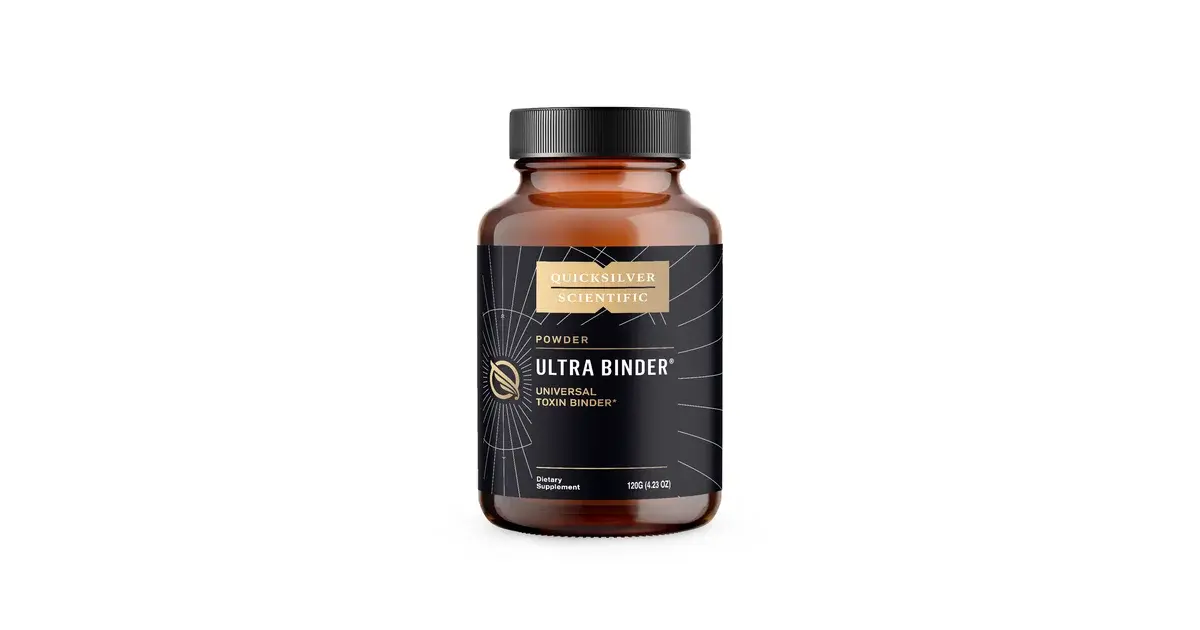
Quicksilver Scientific Ultra Binder
Ultra Binder is a broad-spectrum binder from Quicksilver Scientific. It combines several of the materials above in one product.
| Detail | Ultra Binder (powder) |
|---|---|
| Serving size | 4 g (1 rounded teaspoon); 30 servings per 120 g jar; 1 g dietary fiber per serving |
| Fiber/clay blend (1.36 g) | Gum arabic (Inavea™ Original), zeolite, sodium bentonite clay |
| Second blend (2.64 g) | Activated charcoal, chitosan, aloe vera leaf (BiAloe®), silica extract |
| Label directions | 1 rounded teaspoon in 8 oz of water once daily, or as directed by a healthcare professional; 30 minutes before or 2 hours after meals or medication |
| Also available | Capsules, stick packs and a Sensitive Formula |
What we like: several binder types in one product, clear timing instructions, and different forms including a sensitive version.
Keep in mind: individual amounts within the blends are not disclosed, it contains chitosan (shellfish), and like every binder it can reduce the absorption of medication if taken too close together.
View Ultra Binder at Quicksilver Scientific →
Ultra Binder vs. Ultra Binder Sensitive
Quicksilver offers a Sensitive Formula, described as low in sulfur, for people who react to sulfur-containing ingredients. According to the current labels, the Sensitive Formula leaves out the silica extract that the standard version contains; the other ingredients and blend amounts are the same. Check the current labels before choosing, and start with a small amount whichever you pick.
Powder, capsules or stick packs?
| Form | Pros | Cons |
|---|---|---|
| Powder | Lowest price per dose, easy to adjust the amount | Gritty texture, needs mixing |
| Capsules | No taste, easy to take on the go | Several capsules per dose, higher price |
| Stick packs | Pre-measured, good for travel | Highest price per dose |
Working with a practitioner is the best way to decide whether a binder makes sense for you. Find a functional medicine expert near you.
Related reading: Liposomal supplements explained · How to choose a liposomal glutathione
This article is for information only and does not replace medical advice.
Sources
- EU Register of nutrition and health claims (activated charcoal, flatulence; oat beta-glucan, blood cholesterol): https://ec.europa.eu/food/food-feed-portal/screen/health-claims/eu-register
- Product label data: official Quicksilver Scientific product pages (Ultra Binder, Ultra Binder Sensitive)
Frequently Asked Questions
What is a "biotoxin binder"?+
Can binders bind my medication?+
How long should I take a binder?+
Is activated charcoal safe?+
Do binders help with weight loss or bloating?+
Can I take a binder every day?+
Why do binders cause constipation?+
Do binders turn stools black?+
Disclaimer: The information in this article is for educational purposes only and does not constitute medical advice. Always consult a qualified healthcare professional before making changes to your health regimen.